Preparing for Leadership Through Real-World Experience
Second-year Saint Louis University Master of Health Administration student Ishan Singh is blending his love for the business world with his passion for health economics to advance efficiency and equity in health care.
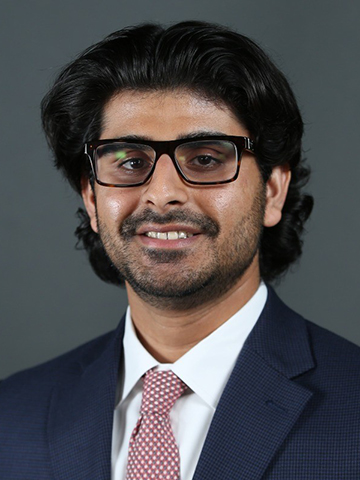
Singh’s original interest at SLU in neuroscience and economics helped him to home in on strengths that were deeply rooted in his fascination with macroeconomic policy, behavioral economics, sociology, and international trade trends. Those interests led him to the health administration field and Saint Louis University’s M.H.A. program.
Singh hasn’t looked back, diving deeper into how all of his interests marry together to lead to a common goal and a common good. The SLU M.H.A. program has afforded Singh the ability to explore these interests while preparing him for leadership in the post-graduate world.
In his second year in SLU’s M.H.A. program, Singh holds an internship with the Washington University School of Medicine in St. Louis. There, Singh assists on special projects ranging from finance (revenue cycle, physician compensation, billing, financial sustainability analyses) to operations (credentialing, scheduling, physician/APP shift reconciliations), and long-term strategy (five-year strategic plan, departmental reviews, business plans, national surveys).
He also works cross-functionally with other departments, Barnes-Jewish Hospital, and the Joint Office of Strategic Planning. SLU’s M.H.A. program has prepared him for success in complex organizations, he says.
The (SLU) M.H.A. program does an exceptional job preparing you to move seamlessly across a complex organization," he said.
"WashU is a dynamic environment that has offered me a lot of growth, opportunity, and crucial exposure to both physician and administrative leadership across multiple departments, not just within (emergency medicine),” Singh said. “I’ve been able to communicate and work with people across hierarchies and disciplines due to the rigor of the (SLU) M.H.A. program.”
The complexities of the organizations and structures he’s interned at have helped create the ability to work with autonomy and learn in a hands-on environment.
Currently, Singh is working on coordinating WashU emergency medicine's participation in the Academy of Administrators in Academic Emergency Medicine (AAAEM) annual benchmark survey as a part of his internship.
“There is an extraordinary amount of operational and financial data required to complete the survey, meaning I got to put on my project management hat these past few months and connect with various stakeholders across WashU/BJC to make sure that concerns were immediately addressed, timelines were clearly communicated and enforced, and the data collection and entry was seamless,” he said.
Singh has gained real-world experience through the SLU M.H.A. program, and he has also worked on effective communication strategies while building trust with colleagues and supervisors.
Following up with summaries, thanking colleagues for their input, and above all, being respectful and consistent with communication are crucial in professional relationship-building, he said.
Through his internship, Singh has built his professional brand, allowing him to learn from each relationship.
“Your internship experience is a vehicle to discover yourself and your interests, but how you communicate it is through your resume and your LinkedIn profile, posts, and experiences. That’s most people’s first impression of you professionally before they’re even able to meet you,” he said.
Singh leverages every experience in this space by being mindful of how he’s being perceived and profiled, in any setting including LinkedIn or a face-to-face coffee chat.
Every SLU M.H.A. student has the opportunity to integrate internship experiences while developing their leadership and professional skills.
Singh’s advice for future M.H.A. students is to treat every day at your internship as a new opportunity to practice leadership and professionalism.
“Every task, every project is an opportunity to experiment with your communication skills, critical thinking, relationship-building, and emotional intelligence, just be mindful that you’re still being entrusted to address real operational challenges. I’ve found that keeping my antennas up for feedback, internalizing lessons in leadership, building relationships across departments, and regularly engaging in reflection and meditation is helping me test my limits and grow as a leader,” he said. “When you see an effective leader that effectively models these traits, take notes and humbly ask for advice. Above all, leadership and professionalism are a habit, a muscle to be trained like any other. You can and should practice both without having the title so that you can make the most of your early professional years.”
College for Public Health and Social Justice
The Saint Louis University College for Public Health and Social Justice is the only academic unit of its kind, studying social, environmental and physical influences that together determine the health and well-being of people and communities. It also is the only accredited school or college of public health among nearly 250 Catholic institutions of higher education in the United States. Guided by a mission of social justice and focus on finding innovative and collaborative solutions for complex health problems, the college offers nationally recognized programs in public health and health administration.